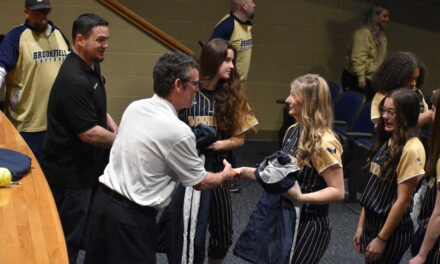

Dr. Taylor Brooks discusses cancer cells for a class of Brookfield High School students.
This story is the last of a series on the members of the Brookfield Distinguished Alumni Hall of Fame Class of 2025.
“Every single day, multiple times a day” that Dr. Taylor Brooks sees patients, he tells someone that he or she has cancer.
“There’s a right way and a wrong way to do it,” he said.
The right way to do it starts with a “warning shot,” an indication that something is wrong, Brooks said. Then, he directly tells the person he or she has cancer.
“There’s no, ‘This might be,’ or ‘I think it’s this,’” he said. “It is or it isn’t. Tell the person, break the news, have them absorb that, give them time to process it.”
The discussion does not end there, he said, and the next thing he tells the patient is very important: “Here’s my plan.”
Sometimes, the telling of the plan turns around the mood of what is a very tough discussion, Brooks said.
“People don’t come to see me because they’re happy,” he said. “People come to me because they’re afraid.”
Outlining the plan to treat cancer can make the patient more comfortable, and Brooks sometimes will see a smile on the patient’s face by the end of the conversation.
“If that happens, there’s nothing better than that,” he said.

Dr. Taylor Brooks, right, receives the plaque for his induction into the Brookfield Distinguished Alumni Hall of Fame from Dan Deramo.
Brooks said he knew he wanted to be a doctor – to help people – since about middle school, when his mother, Sue Ann, was diagnosed with breast cancer and he observed the positive relationship she had with her cancer doctor.
After graduating from Brookfield High in 2009, Brooks started his 14-year college odyssey with stops at Ohio State University, the University of Cincinnati, Wake Forest Baptist Medical Center and Cleveland Clinic, where he now works.
“I’m a blood doctor,” Brooks said. “I take care of patients who have blood disorders and cancers called lymphoma. I also work to lead clinical studies and clinical trials, trying to get patients tomorrow’s therapies today.”
Lymphoma is cancer of the immune system, and there are more than 100 different kinds, he said. “I gotta know how to treat all of them.”
He also has to know how to treat patients who may have some of the classic signs of lymphoma, such as swollen lymph nodes, but tests do not detect cancer. Possible diagnoses for these patients include an infection, pneumonia or an autoimmune disease, he said.
“It is kind of like detective work, which I think is a lot of fun, to get information from blood tests, talk to somebody about what they’re experiencing, and then putting that information together to try to do a little more evaluation to come to a final diagnosis and then to manage them,” Brooks said.
The preparation Brooks puts into his work with patients impresses his wife, Dr. Cassandra Brooks, an ophthalmologist.
“He is so passionate about trying to improve care for the population as a whole, people with cancer, but the ability to wake up every day at 4 a.m., before the sun even thought of waking up, to start charting and prepping and being prepared so you can take care of people each morning is really awe-inspiring,” she said. “The way you treat all your patients like family is really magical.”
Although he’s still paying off his college student loans, Brooks said the journey was worth it.
“I know that I love this,” he said. “I couldn’t do anything differently.”