
Following the opening volleys of the American Revolutionary War, fired at Lexington and Concord in Massachusetts in 1775, much of the war was fought along the eastern seaboard.
But, the British had a presence far inland and had built a fort in Detroit. As a tactical maneuver, the British set out to distract the American military efforts in the east by “causing trouble” for American settlers in the Ohio country, said Kate Pfouts, archivist for the Trumbull County Historical Society. The closest American military presence was in Pittsburgh, far away from Detroit.
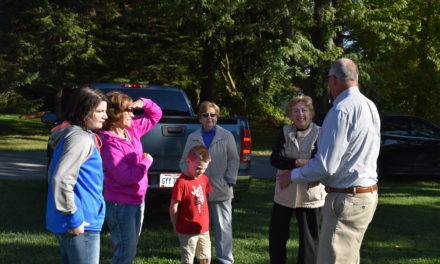
“There’s already been tension between the Native Americans and the colonists who are settled” in the Ohio country, Pfouts said in a presentation Aug. 15 at the Brookfield Branch Library. Settlers were “not supposed to be in the Native Americans’ lands. There’s little skirmishes happening in the Ohio country, between the settlers who are out there and the Native Americans, who are trying to keep their homes.”
The majority of the Native Americans who chose sides sided with the British, long-time trading partners.
The rebels decided they needed to build a series of forts that would allow them to pass from Fort Pitt in Pittsburgh to within striking distance of Fort Detroit, and settled on the Tuscarawas Valley, south of what is now Canton, for the first fort, Fort Laurens.
In preparation for building Fort Laurens, the Americans entered into a treaty with a clan of the Delaware/Lenape tribe, whose members already lived with settlers, particularly Moravian missionaries, in the Ohio country. One of the key aspects of the treaty was that the Delawares were to provide safe passage for the American soldiers to get from Fort Pitt to Fort Laurens, Pfouts said.
The Continental Congress authorized Col. Laughlin McIntosh, who was in charge of troops that would build Fort Laurens, to draw up plans for Fort Laurens in 1778, but specified that the party not leave for the Tuscarawas Valley unless it could be properly provisioned by September.
“Laughlin McIntosh did not listen,” Pfouts said. “They did not leave for the Tuscarawas Valley until mid-October.”
The fort was completed in December 1778 and manned by 1,200 soldiers – 1,200 soldiers who did not have enough food or ammunition and whose clothing was an insufficient barrier against the cold Ohio winter, she said. George Washington ordered all but 300 soldiers to leave the fort and head back east.
The British became aware of the fort and joined with their Native American allies to surround the fort, making it impossible for the rebels to safely leave the fort to hunt or gather firewood.
“They’re (Americans) trapped inside this fort,” Pfouts said.
What little provisions the Americans received came from the Delawares, who had relationships with the British-allied Native Americans and could “sneak in” to the fort, she said. But, the soldiers existed on the margins of survival.
“They resort to boiling their moccasins,” Pfouts said. “That’s how desperate they are, at this point. They start eating their horses.”
The Americans soldiers in Fort Laurens were replaced by a crew of 180, but it became obvious to the Americans powers that be that Fort Laurens “isn’t gonna do what we wanted it to do,” Pfouts said. “We needed it to be that steppingstone to get from Fort Pitt to Fort Detroit and it ultimately failed.”
By August 1779, Fort Laurens was abandoned and the American settlers in the Ohio country were left on their own, many forming militias for protection against the British and their Native American allies.
After Fort Laurens, “We don’t really get a whole lot happening in Ohio until post-War,” Pfouts said.
Following the war, many veterans moved into the Ohio country – Ohio became a state in 1803 – and 7,000 are buried here. Only Massachusetts has more Revolutionary War veterans buried in it than Ohio, Pfouts said.
The original fort no longer exists, but the site is owned by the Zoar Community Association on behalf of the Ohio History Connection and is open to visitors from May to Nov. 15. Archaeological research has identified the original boundary of the fort and revealed artifacts that support the fort’s historical record, Pfouts said.
@@@
Ohio History Connection has announced the launch of an online dashboard listing the final resting places for 4,300 Revolutionary War veterans buried in Ohio, including those in Brookfield Township Cemetery.
The dashboard shows the location of those grave sites, photographs of headstones and any information known about the soldiers.
The dashboard identifies these soldiers buried in Brookfield, with biographical information provided by Lois Werner in her book “The History of Brookfield Township, Trumbull County, Ohio”:
- Samuel Wilson – born in Scotland, he was a Pennsylvania colonel. He died in 1820.
- Isaac Hosford – born in Vermont but was living in Connecticut when he enlisted. He died in 1826.
- Bliss Hart – a fifer from Connecticut who helped write the Connecticut Constitution. He arrived in Brookfield in 1823 and died in 1831.
- Daniel Williams – a private from Connecticut. He died in 1835.
- Abram DeForest – a courier from New Jersey. He died in 1847.
- Philip Wintersteen – an ensign from New Jersey. He died in 1829.
- Ethan Newcomb – a private from New Jersey. He arrived here in 1801 and died in 1849.
- John Tribby – a sailor on the Confederacy, a 36-gun frigate captured by the British in 1781. He was released in a prisoner exchange. The native of Rhode Island arrived here in 1810 and died in 1819.
- Timothy Alderman – a private from Connecticut. He died in 1815.
- Henry Taylor – a private from New Jersey. He was born in Pennsylvania and died in 1855.
- Stephen Doughton – a gunsmith from Wales. He co-founded the first iron furnace in Niles. He died in 1830.
The grave sites of four others also are listed, although there are no markers for these soldiers and their names are not listed.
Werner lists another Revolutionary War vet not included on the dashboard: James McMullin, who served in the Pennsylvania militia as a private. He was the first known person to buy land from Samuel Hinckley, who founded Brookfield Township. McMullin was a blacksmith and his shop became Brookfield’s first business. He lived on Warren Sharon Road west of Yankee Run Road, the property of Yankee Run Golf Course, now owned by his descendants.
Werner added that it has been learned that Jacob Reeder, also buried in the Brookfield cemetery, served in the Revolutionary War. He was born in New Jersey in 1742 and served as a private and a master armorer in the Continental Army from 1776 to 1777. He moved to Brookfield, where he died in 1826. His wife, Eunice, and two sons, Jesse and Benjamin, also are buried in Brookfield Township Cemetery.
The dashboard also lists Jacob Humason, who died in 1829, as a Revolutionary War veteran, but Werner said her research indicates he served in the War of 1812. His grave registration card in the Trumbull County archives lists his birthdate as 1769, making him six years old when the war’s first shots were fired in 1775.
The Ohio Revolutionary War Veterans Graves Project is a partnership of America 250-Ohio, Ohio State Historic Preservation Office, Terracon Consultants Inc. and Sons and Daughters of the American Revolution. The dashboard is at Ohiohistory.org